Moving to Mexico: the complete, date-checked guide
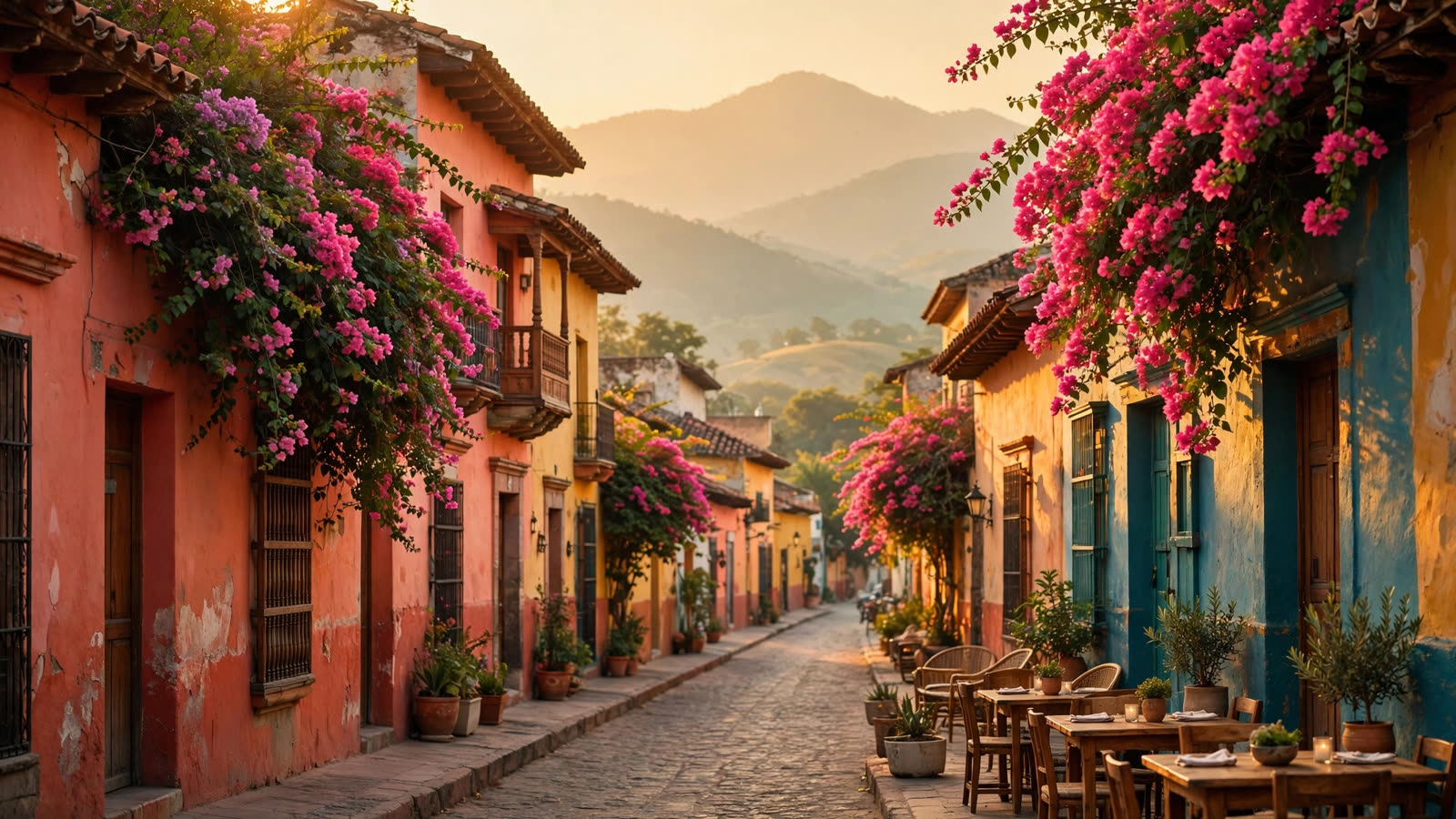
The biggest expat magnet in the Americas — a consulate numbers game, then a very liveable country.
An ordinary Tuesday: a mercado run where breakfast is whatever's ripe, lunch — the main meal — at a fonda for the price of a coffee back home, an afternoon in the plaza shade, and tacos al pastor standing up at 9pm because the stand finally opened. Time is looser here, and so, eventually, are you.
Rent from ~$450/moYour money goes ~71% further than in the USEntry line: ≈US$4,340–4,630/mo income for 6 months (consulate-dependent)Emergency: 911
1-bed from ~$450/mo in expat-favourite cities like Mérida or Oaxaca (indicative, checked Nov 2026) · Cost anchors are indicative — the residency figures below are the verified ones.
Advertisement
Mexico is where the most Canadians and Americans actually land — close, cheap, culturally rich, and with a residency system that is essentially a paperwork exercise: prove about US$4,300–4,600 a month of income (or a solid savings balance) at a consulate, swap the visa for a resident card within 30 days of arrival, and you're legal for a year, then four, then forever. The catches are procedural, not financial: consulates each interpret the rules a little differently, appointment slots are scarce, and there is no converting a tourist entry once you're in. Do the consulate step properly and Mexico is one of the smoothest moves on this list.
The residency routes
Temporary Resident — economic solvency
The main door. Prove monthly income of roughly 680 times the daily minimum-wage unit (UMA) over the last 6 months — consulates vary, so MovePath tests you against the TOP of the range — or an average savings balance over 12 months. One year first, renewable to four.
The line: ≈US$4,340–4,630/mo income for 6 months (consulate-dependent)
Working: The card arrives WITHOUT work authorisation — the intended use is living on foreign income, and remote work for foreign employers/clients is unrestricted in practice. For a Mexican job you need a separate INM work permit (permiso para trabajar) plus a tax number (RFC).
How long: 1 year, renewable up to 4 years total.
Leads to: Permanent residency after 4 consecutive years (2 if married to a Mexican) — with no further financial test at conversion.
Source: INM solvency criteria (680× UMA 2026) via Mexican consulates · checked Nov 2026 · secondary · ⟳ UMA is revalued every February (INEGI) — every threshold in Mexico moves with it, and consulates convert at their own exchange rate.
Permanent Resident — direct (retiree)
Skip the temporary years: consulates can grant permanent residency directly to pensioners who clear a higher line — about 1,140× UMA in pension income, or a much larger savings balance. Some consulates also expect retirement age — ask yours.
The line: ≈US$7,320–7,400/mo pension income (1,140× daily UMA)
Working: Permanent residents have full work rights in Mexico — no separate permit needed.
How long: Permanent — no renewals (card refresh only).
Leads to: Citizenship after 5 years of legal residence (2 for spouses of Mexicans and parents of Mexican-born children), with Spanish and history exams.
Source: INM permanent-resident solvency via consulates · checked Nov 2026 · secondary · ⟳ UMA revalues every February; the savings multiple is the least-standardised figure in Mexican practice — verify at your consulate.
Temporary Resident with work permit (employer route)
Your Mexican employer must be registered with INM as an employer; they file the job-offer authorisation (you get a NUT case number), then you interview at a consulate for a work-authorised resident visa tied to that job.
The line: A job offer from an INM-registered Mexican employer
Working: Local work rights for the sponsoring employer and role. Your residency carries work permission from day one on this route.
How long: 1 year, renewable to 4.
Leads to: Permanent residency after 4 years.
Source: INM employer-registration & NUT process · checked Nov 2026 · secondary · ⟳ Rules-based, not a money figure.
Family Unity (Unidad Familiar)
Spouse of a Mexican citizen? Family Unity gives temporary residency for 2 years, then permanent — with NO solvency test. Unusually, this one can be filed inside Mexico at INM.
The line: Marriage/family link to a Mexican citizen or resident
Working: Family-unity residents can apply for work authorisation; permanent residency (year 2) carries full rights.
How long: Temporary 2 years → permanent.
Leads to: Permanent residency, then citizenship after 2 years for spouses of Mexicans.
Source: Migration Law Art. 53 — INM · checked Nov 2026 · secondary · ⟳ Rules-based, not a money figure. Civil documents need apostille + official (perito) translation.
→ Test these routes against YOUR income in the planner
Who can just show up?
There are NO visitor extensions in Mexico — when your days run out, you leave, or you hold residency. And a hard rule that surprises people: Temporary Residency must be started at a Mexican consulate abroad. You generally cannot convert a tourist entry into residency from inside Mexico (family and work routes aside).
Health
Must-have insurance: No insurance is required for Mexican residency — any website selling you a 'mandatory' policy for the visa is inventing a rule. Cover is still a genuinely good idea from day one; you just choose it yourself.
Public system: Residents can voluntarily enrol in IMSS (Seguro de Salud para la Familia, Modalidad 33) for an annual fee by age — 2026 fees run ≈14,350–14,850 MXN/yr at ages 40–59 and ≈20,600–21,500 MXN at 60+ (≈US$800–1,200). Pre-existing conditions carry exclusions and waiting periods, which is why many residents pair IMSS (for catastrophes) with private cover or cash-pay private care.
Private costs: Local private plans ≈US$100–300/mo; at 60, budget ≈US$320–500/mo — and note most Mexican insurers stop issuing NEW policies around age 64–70, so buying before that window closes matters (estimates, checked Nov 2026). Cash-pay private care is famously affordable: specialist visits often US$40–80.
Services that can help
- Compare expat health insurance (partner link coming soon)
Safety — can you walk the streets at night?
It depends entirely on where — Mexico is a continent-sized country wearing one name. In the cities and neighbourhoods expats settle in (Mérida — routinely ranked among the safest cities in the Americas — plus CDMX's Roma/Condesa/Polanco, Oaxaca City, the Lake Chapala towns), evening strolls are ordinary life. In border cities, parts of Guerrero, Michoacán and other cartel-contested areas, the answer is simply no — and those areas carry 'avoid non-essential/all travel' regional advisories. Pick your city like it matters, because it does.
Official advisory (Government of Canada, checked Nov 2026): Exercise a high degree of caution (with regional advisories — several states are avoid-non-essential or avoid-all-travel) — check the live advisory.
Homicide rate: 24.9 per 100,000 (2023, UNODC via World Bank).
Money & tax
Everyday costs run roughly 40% below US levels on country averages — but expat enclaves (Roma/Condesa, Playa del Carmen, Ajijic) price closer to home for rent and restaurants. Live one neighbourhood out and the arithmetic gets very friendly.
Tax: Mexico has NO 183-day tax-residency test: you're tax-resident when your home is in Mexico — or, if you keep homes in two countries, when your centre of vital interests is (>50% Mexican-source income or main professional base). Residents are taxed on worldwide income (top rate 35%) and need an RFC. Many retirees' advisors manage this carefully — get Mexican tax advice in year one. Note some sources claim a 183-day rule; Mexico's Federal Tax Code Art. 9 doesn't have one.
Banking: Tourists generally can't open a standard account. With a resident card + CURP it's a same-day branch visit; an RFC is often requested too. Keep your home accounts — receiving pensions into Mexico is routine.
Services that can help
- Send money internationally for less (partner link coming soon)
- Land connected: travel eSIMs (partner link coming soon)
First steps
- Pick your consulate and book the residency appointment FIRST — in Canada and the US, slots are the bottleneck, and every document deadline hangs off that date. ⏱ Book 1–3 months ahead · Free to book
- Assemble 6 months of income proof (or 12 months of savings balances) in the exact format your consulate lists — consulates differ, and Mexico rewards doing it their way. ⏱ 2–4 weeks of gathering · Free
- Attend the consulate interview and get the visa sticker placed in your passport. ⏱ Same day, usually · Consular fee (MXN-denominated, varies)
Questions, answered
Can I apply for Mexican residency after I arrive?
For the standard solvency route: no. It starts at a Mexican consulate in your country of residence — entering as a tourist and converting in-country isn't an option (family-unity and work cases aside). Once the visa is in your passport, you complete the canje at INM within 30 days of entering.
Why do consulates quote different amounts?
The law sets solvency in multiples of the UMA unit (680× daily UMA for temporary-resident income), and each consulate converts to local currency at its own rate and rounds differently. Budget for the top of the US$4,340–4,630/mo range and you clear any consulate.
Can I work remotely on Temporary Residency?
Yes — the card is issued without local work authorisation, and living on foreign income is its intended use. A Mexican job needs a separate INM work permit plus an RFC.
Is health insurance required?
No — Mexico requires none for residency. Residents can buy into IMSS voluntarily (≈US$800–1,200/yr by age) or pay privately; private care is good and cheap by North American standards.
When am I tax-resident in Mexico?
When your home is in Mexico (or your centre of vital interests is, if you keep two homes) — Mexico has no 183-day rule. Residents are taxed on worldwide income, so take Mexican tax advice early.
Sources
Figures checked Nov 2026. MovePath is guidance, not immigration legal advice — confirm with the consulate before committing money.